
DTCC Tokenization Service in 2026: How Tokenised Securities Could Change the Role of Crypto Exchanges
Tokenisation of traditional securities has moved well beyond small blockchain experiments in 2026. The Depository Trust & Clearing Corporation is preparing the DTCC Tokenization Service for an October launch after its subsidiary, The Depository Trust Company, successfully used tokenised DTC-held assets in real production transactions in July. This matters because DTC sits at the centre of the US securities system and holds assets worth more than $114 trillion. Its entry into tokenisation therefore raises a much larger question than whether shares or Treasury securities can exist on a blockchain. If regulated securities can move between registered digital wallets while retaining the same ownership rights and investor protections as their conventional equivalents, some services historically associated with crypto exchanges could gradually become part of mainstream securities infrastructure. Crypto exchanges are unlikely to disappear, but their role may shift from providing a separate market for blockchain assets towards supplying regulated access, liquidity, custody, wallet services and connections between conventional finance and tokenised markets.
What the DTCC Tokenization Service Actually Changes in 2026
The most important point is that DTCC is not creating synthetic blockchain copies of US shares with unclear claims on an underlying asset. The service developed by DTC is designed to represent securities entitlements connected to assets already held within DTC. When an eligible position is converted into tokenised form, the conventional entitlement is moved into DTC’s designated account structure and a corresponding tokenised entitlement can be delivered to a registered digital wallet. DTC continues to maintain the official records and reconcile the tokenised position with the underlying securities. In practical terms, blockchain becomes another way of representing and moving an entitlement within an established securities custody framework rather than a replacement for the legal structure behind the asset.
The initial range of eligible assets is deliberately conservative. Under the SEC staff no-action relief obtained by DTC in December 2025, the service can initially cover highly liquid securities including constituents of the Russell 1000, exchange-traded funds tracking major indices, and US Treasury bills, notes and bonds. These are very different instruments from the long-tail crypto tokens normally associated with blockchain trading. They belong to some of the deepest and most closely supervised markets in the world. DTC has also stated that tokenised and conventionally recorded versions will carry the same ownership rights and investor protections. This distinction is crucial for investors because buying a token that merely tracks the price of a stock is not necessarily the same thing as holding a recognised entitlement to that security.
Timing is equally important when assessing the state of the service in 2026. DTCC announced in May that limited production transactions would take place in July before a planned October launch. On 15 July, it confirmed that assets held at DTC had been converted into tokens and used in real production transactions involving multiple asset classes and industry participants. That was a substantial change from laboratory testing because real assets and operational workflows were involved. Full commercial availability, however, is still planned for October 2026, so the market remains in a transition period as of August. The SEC relief also provides for a three-year initial period, giving DTC time to operate, evaluate and refine the service rather than treating its first version as the final model for tokenised US securities.
From DTC Custody to Blockchain-Based Securities Entitlements
The process can be understood without going deeply into blockchain engineering. A DTC participant that wants an eligible security in tokenised form instructs DTC to convert the relevant position. The traditional security supporting that position does not vanish. DTC keeps control of the underlying entitlement within its existing records while creating a token representing the participant’s securities entitlement. That token can then be delivered to a digital wallet registered with DTC. The arrangement allows an institution to work with a blockchain-based representation while the connection to established custody records remains intact. A participant can also request conversion back into the traditional book-entry form, making tokenisation a reversible choice rather than a permanent migration of the security away from DTC.
Once tokenised, DTC securities can be moved directly between registered participant wallets on supported blockchain networks. DTCC says these wallet-to-wallet movements can take place around the clock. That feature is significant because conventional securities infrastructure has traditionally been organised around defined trading, clearing and settlement schedules. A tokenised entitlement that can move on a Sunday evening or outside US market hours creates new possibilities for collateral transfers, institutional treasury management and cross-market transactions. It does not automatically mean that ordinary investors will be able to trade every tokenised US share twenty-four hours a day. The availability of trading still depends on brokers, regulated trading venues, market makers, liquidity and applicable securities rules.
There is also an important limitation that prevents the 2026 service from being described as a complete blockchain replacement for conventional settlement. DTCC’s published service information states that, at launch, associated value transactions will not themselves be settled in digital form through DTC. Participants can move DTC tokens between registered wallets on a free-of-value basis, but a tokenised security that needs to be used for traditional end-of-day DTC settlement must be converted back into a book-entry entitlement. Some corporate actions may eventually be handled on-chain while others will initially continue through established processes. The first version is therefore a bridge between two forms of market infrastructure rather than an entirely separate financial system operating solely on blockchain rails.
Why Tokenised Securities Could Alter the Economics of Crypto Exchanges
Crypto exchanges grew partly because blockchain assets required specialist infrastructure that traditional brokers and securities institutions did not initially provide. Users needed accounts capable of trading digital assets, specialised custody arrangements, blockchain deposits and withdrawals, and liquidity for assets that did not trade on conventional stock exchanges. Tokenised securities narrow part of that technological gap. If major brokers, custodians and financial institutions can hold recognised securities entitlements in registered wallets and move them through approved blockchain networks, blockchain functionality no longer belongs exclusively to crypto-native businesses. The competitive question shifts from who can support a blockchain token to who can provide reliable access, liquidity, custody, compliance and execution for regulated assets that happen to use blockchain records.
This could be particularly important for crypto exchanges that have spent years building wallet systems, blockchain monitoring, transaction infrastructure and round-the-clock operations. Their technical experience may remain valuable, but tokenised securities bring a very different regulatory framework. The SEC made clear in its January 2026 staff statement that a security does not stop being a security merely because its ownership is represented through a crypto network. Stocks, bonds and other regulated instruments remain subject to securities law when tokenised. A crypto exchange therefore cannot assume that the regulatory arrangements used for spot trading of non-security crypto assets are sufficient for tokenised equities or Treasury securities. Activities involving brokerage, securities trading, custody or regulated market operation may require additional licences, registrations and controls.
The competitive pressure will also move in both directions. Crypto businesses may seek a greater role in regulated securities markets, while conventional financial institutions are gaining capabilities once associated mainly with crypto firms. DTCC’s industry work on the service has involved more than 50 organisations from both traditional finance and digital assets, including asset managers, banks, brokers, custodians, market infrastructure firms and blockchain specialists. That mixture is a useful indication of where the market may be heading. The dividing line between a conventional securities company and a crypto company becomes less useful when both can work with digital wallets and tokenised assets. Competition may increasingly centre on execution quality, asset safety, costs, liquidity and regulatory access rather than on blockchain support alone.
Crypto Exchanges May Become Access and Liquidity Intermediaries
One possible role for regulated crypto exchanges and their affiliated companies is to become an access layer between clients and tokenised securities infrastructure. Direct participation in the DTC service is limited to DTC participants and their clients, so possession of a crypto trading business does not by itself provide direct access. A company would need an appropriate regulated relationship, either through its own eligible entity or through established financial intermediaries. For businesses that can satisfy those requirements, the customer-facing experience could eventually resemble familiar crypto trading: an investor sees an asset balance, places an order and manages digital holdings, while the legal ownership and post-trade processes underneath are connected to regulated securities infrastructure.
Liquidity could be another major area of change. Crypto exchanges are experienced in maintaining markets that operate outside the traditional US equity trading day, while tokenisation creates the possibility of moving securities entitlements outside conventional hours. If securities rules and trading arrangements continue to develop in that direction, market makers may have to manage liquidity across conventional shares, tokenised equivalents and potentially several approved blockchain networks. The important challenge will be preventing liquidity from becoming unnecessarily fragmented. DTCC’s model may help because the tokenised entitlement remains connected to the conventional asset rather than becoming a completely separate synthetic instrument. Conversion between traditional and tokenised forms could therefore help connect pools of liquidity instead of forcing investors into isolated markets.
Custody may become just as important as trading. Crypto exchanges have traditionally earned revenue from execution, spreads, listings and custody of digital assets, but institutional tokenised securities could increase demand for specialised wallet administration and regulated digital custody. Investors will need to know who controls private keys, what happens when access credentials are compromised, how an asset can be recovered, how corporate actions are received and which entity is legally responsible for the entitlement. DTC’s approach gives it administrative controls and requires registered wallets, while participants remain responsible for their own customers and compliance duties. Exchanges entering this area will therefore have to compete not merely on the ease of sending a token but on the quality of their custody, record-keeping, compliance and operational safeguards.
What the Change Means for Investors, Brokers and Crypto Exchanges
For investors, the biggest potential benefit is not simply that a stock can appear inside a blockchain wallet. The more meaningful change is greater mobility of recognised financial assets. A Treasury security or equity position that can move between authorised wallets outside conventional operating windows could eventually be used more efficiently as collateral or transferred more quickly between financial institutions. Tokenisation may also reduce some of the manual reconciliation that occurs when several organisations maintain separate records of the same transaction. Those benefits depend on broad adoption, however. An asset that technically moves twenty-four hours a day offers limited practical value if counterparties, trading venues, payment arrangements and compliance systems are unavailable at the same time.
Investors should also distinguish DTC-tokenised securities from the many products already marketed online as tokenised stocks. The SEC’s 2026 description of tokenised securities recognises several possible structures, including securities tokenised by or for an issuer and arrangements created by third parties. The rights attached to these structures can differ substantially. A third-party token referencing the price of a public company may expose its holder to the issuer or custodian of the token in ways that direct ownership of the company’s shares would not. By contrast, DTC’s service is designed so that its tokenised entitlement preserves the rights and protections associated with the underlying DTC-held security. The word “tokenised” therefore describes the format of an asset but does not, by itself, tell an investor what is actually owned.
For brokers and exchanges, this makes transparency a competitive necessity. A service offering tokenised shares will need to explain whether the client owns the security itself, a securities entitlement, a claim on an intermediary or another instrument linked to the security’s value. It will also need to make clear where the underlying asset is held, which regulator supervises the relevant entity and what happens during insolvency or a technical failure. Familiar blockchain features such as a visible wallet balance or rapid transfer cannot substitute for these legal details. Companies that make ownership structures easy to understand may have an advantage as tokenised assets become more widely available, particularly among investors who are comfortable with crypto trading but less familiar with securities custody and settlement.
The Likely 2026–2027 Transition Is Coexistence Rather Than Replacement
The near-term direction points towards coexistence. DTCC is not abandoning its conventional books and records, and its first tokenisation phase deliberately keeps traditional and tokenised securities side by side. Participants can choose whether eligible holdings are converted and can return them to conventional form. Some operations remain off-chain, and the initial service does not provide full digital cash settlement. This approach reduces the need for banks, brokers or investors to migrate every process at once. It also means that existing stock exchanges, central securities infrastructure and crypto exchanges are more likely to become interconnected than to replace one another during the first stage of adoption.
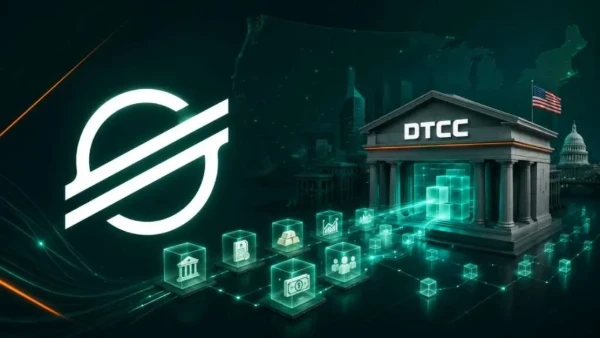
Blockchain connectivity is also expected to expand gradually rather than through a single network. DTC intends to support only blockchain networks that meet its requirements for resilience, reliability, security and compliance. In May 2026, DTCC and the Stellar Development Foundation announced plans to make DTC-tokenised assets available through Stellar during the first half of 2027. DTCC has also been working with Digital Asset and the Canton Network on tokenisation of DTC-custodied US Treasury securities. A multi-network model could create opportunities for crypto businesses that specialise in wallet infrastructure, institutional connectivity and cross-network operations, although interoperability will need careful control if securities are represented across different technical environments.
The broader change for crypto exchanges is therefore likely to be a change in identity rather than a simple expansion of the assets available for trading. A large exchange that wants meaningful exposure to tokenised securities may increasingly resemble a combination of broker, regulated trading venue, digital custodian and blockchain infrastructure provider. At the same time, traditional securities firms are likely to adopt more of the wallet and blockchain functions previously associated with crypto businesses. DTCC’s 2026 service accelerates that convergence because it connects blockchain-based asset movement to one of the most important securities depositories in the world. If the October launch and subsequent three-year programme operate successfully, the long-term competitive advantage may no longer come from offering crypto access alone. It may come from giving clients trustworthy access to conventional and digital assets through the same regulated financial relationships while preserving clear ownership, liquidity and investor protection.